Detailed schedule and resources
Class 12
This class is delivered by asynchronous video lecture:
Class 11
Announcements:
- Explanation of exam curving and retake policy.
- The exam questions and solutions are on Brightspace.
- You should have received a grade report. Let me know of any questions after class.
- Discussion of the exam answers will take place next time we meet in person.
- The next class (Thursday Oct 8) will be via asynchronous video lecture. Check back here on Detailed Schedule page for details.
Today’s material: Ch 5, first part (pages 146-157), Activities 5.1-5.5 (pages A-20 to A-23).
- [3:10pm] pages 147-149: read at home.
- pages 150-151: Event, simple event, sample space.
- [3:15pm] Activities 5.1-5.2, page A-20: do in class if time allows, otherwise complete at home (DICITAOCAH).
- pages 151-154: probability model, union, intersection, complement.
- page 154: fill in. (in class)
- page 155: mutually exclusive events.
- [3:40pm] Activity 5.3, page A-21: DICITAOCAH
- still page 155: Probabilities for equally likely events
- [3:50pm] Activity 5.4, page A-22: DICITAOCAH
- page 156: Addition rule.
- [4:00pm] Activity 5.5, page A-23: DICITAOCAH
- page 157: Addition rule for mutually exclusive events
Class 10
Exam 1.
Class 9
Optional event tomorrow night: 7pm ATS – Can a computer program think like a human?
Exam revision.
- Bring questions to class.
- Remember you will need an approved non-graphing non-programmable calculator for the exam. (Purchase for $5 from instructor if desired.)
- No bathroom breaks in the exam.
- Write answers on your own paper.
Class 8
Announcments:
- Minitab datasets available
- PDF version of HW4 is available. You can use this or the MS word version.
- Exam details are on home page.
- Get your calculator approved! (Or buy one from the instructor for $5.)
- HW3: Note how to describe a distribution in words correctly
- Give a single typical value for the center.
- Give a range of values where most of the data lies.
Today: Remainder of chapter 4, pages 134-145
- [3:10pm] Answers to Activities 4.1, 4.2, 4.3.
- [3:15pm] Influential points and outliers, p135-137
- [3:25pm] Coefficient of determination, p138-139
- [3:40pm] Example 4.2, p140-141.
- [3:50pm] Minitab lab, pages 142-145 in pairs.
- Instructions for launching Minitab can be found in the Minitab instructions.
- You will need the data file OJuice.mtw.
Class 7
Clarification from last time: a quartile is just a single number, not an interval:
- The first quartile, \(Q_1\), is the 25th percentile.
- The second quartile, \(Q_2\), is the 50th percentile (the median).
- The third quartile, \(Q_3\), is the 75th percentile.
- The interquartile range (IQR) is the difference \(Q_3 - Q_1\).
Announcement:
- For the exams, you can use a scientific, non-graphing, non-programmable calculator. You can buy one from me for $5 if you want.
Today: First part of chapter 4, pages 109-133 + Activities 4.1-4.4, pages A17-19 + Example 4.1, pages 132-133.
Plan:
- [3:05pm] pages 109-117: Read carefully at home. Complete Activities 4.1 and 4.2 at home – the solutions will be provided next time.
- [3:10pm] correlation coefficient, pages 118-121. Activity 4.3 in class if time allows, otherwise complete at home.
- [3:30pm] linear regression, pages 122-129. Activity 4.4 in class if time allows, otherwise complete at home.
- [3:50pm] calculating least squares line (line of best fit) pages 130-131.
- [4:00pm] Example 4.1 – do in class.
Class 6
Announcement: homework 3 was updated 9/17/2026.
Today: Second part of chapter 3, pages 92-108 + Activity 3.2, page A-14 + minitab lab, pages 102-108.
- do Activities 3.3 and 3.4 at home
Plan:
- [3:00pm] return HW1+2, explain grading:
- random subset of questions are graded, then a score for completeness is added, usually marked “cpt”.
- solutions are available on the course website. Each student should check solutions carefully to ensure answers on ungraded questions are correct.
- [3:05pm] p92-93: review the empirical rule (a.k.a. 68-95-99.7 rule).
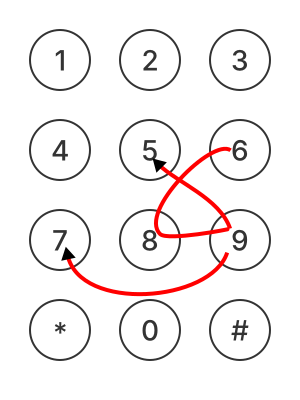
- Mnemonic: Think of dialing these numbers on a phone keypad. It’s a cross in the bottom right corner and then a swoosh across the bottom row – see diagram.
- example 3.3, together in class
- [3:10pm] p94-95: z-scores
- example 3.4 – do at home if skipped
- Activity 3.2, page A-14
- [3:20pm] p96: percentiles
- example 3.5 – do at home if skipped
- [3:25pm] 96-97: Interquartile range (IQR)
- examples 3.6 and 3.7 – do at home if skipped
- [3:30pm] p98: 1.5IQR rule for outliers
- example 3.8 – do at home if skipped
- [3:40pm] p99: five-number summary
- [3:45pm] p99-101: boxplots
- example 3.9 – do at home if skipped
- Activity 3.3, page A-15 – do at home
- Activity 3.4, page A-16 – do at home
- [3:50pm] In-class minitab lab in pairs:
- see Minitab instructions for how to log in to the Minitab web app.
- work through coursepack pages 102-108. Finish for homework.
Class 5
if you have 35 minutes to spare…. ??what are these people talking about??
Today: First part of chapter 3, pages 76-93 + Activity 3.1, page A14.
- p76-82: Measures of center:
- Mean, median, trimmed mean, mode
- p83: Example 3.1, together in class
- p84-91: Measures of spread:
- deviations, mean absolute deviation (MAD), sample variance, sample standard deviation, population variance and standard deviation
- Activity 3.1 (page A-14) – Individually, check with neighbors.
- p92-93: The empirical rule (a.k.a. 68-95-99.7 rule).
- Mnemonic: Think of dialing these numbers on a phone keypad. It’s a cross in the bottom right corner and then a swoosh across the bottom row – see diagram.
- didn’t have time for this: preliminary minitab lab:
- see Minitab instructions for how to log in to the Minitab web app.
- see coursepack page 102 to get started. Go up to and including Histogram on page 106.
Class 4
Today: Ch2, pages 47-75 + Activites 2.1-2.2, pages A11-12
- pp 47-48: read at home
- p49: distribution of a variable
- p50: four definitions
- p52: frequency and relative frequency
- p52-54: histograms. Play around with this histogram demo if you want (Credit: Shodor Education Foundation + Department of Mathematical Sciences, Appalachian State University).
- [3:20pm] pp55-57: stem-and-leaf plots
- pp58-61: shape: symmetric, skewed, uniform, mounds
- [3:30pm] Activity 2.1: Try it on your own, discuss with neighbors.
- [3:40pm] pp62-63:
- Outliers.
- Summary for numerical distributions: shape, center, variability.
- pp64-65: bar chart, pie chart
- pp66-68:
- Summary for categorical distributions: mode, variability.
- [4:00pm] Activity 2.2: Try it on your own, discuss with neighbors.
- pp71-75: Misleading statistics – read at home if we don’t have time to go over in class
Class 3
-
turn in HW0
-
Mnemonics for concepts from last time…
Mnemonic for Type I and II:
Type I rejects a null that’s true.
If the null is false, you’ve got a Type IIMnemonic for p-value:
What does the p-value of x mean?
It’s the chance of x or something more extreme
Today: ch1, pages 22-46; activities 1.1-1.3, pages A7-A10
- This corresponds to chapter 1 of Introductory Statistics: Exploring the World Through Data, by Gould, Wong, and Ryan; 3rd edition (2019), Pearson. ISBN 978-0135188927.
- A copy is on reserve in the library – ask for it at the front desk.
- pages 22-25: read at home
- p26 – Variable types, then activity 1.1 (A7)
- pages 26-29: read at home
- pages 30-31 – Incomplete data
- pages 32-35 – Two-way tables, marginal distribution, conditional distribution
- pages 36-37 – Observational study vs experimental study, units/subjects, response/outcome, explanatory variable/factor, levels, treatment
- p38 – example 1.1 – Together in class
- p39 – Association versus causation, Confounding, lurking variable
- p40 – We skip activity 1.2 and return to it later if time allows – otherwise complete this at home
- p41-43 – read at home
- p44 – placebo effect
- We skip activity 1.3 and return to it later if time allows – otherwise complete this at home
- p45-46 – read at home
-
Activity 1.4 in pairs:
Pair Names 1 Talon & Marissa 2 Abigail & Yixing 3 Carson & Tess 4 Ashlynn & Donovan 5 Ishan & Ella 6 Josh & Lin 7 Matthew & Olivia 8 Bodie & Stephanie 9 Sal & Emma 10 Eli & Quan 11 Landon & Nini 12 Evan & Timi 13 Yoongi Go back to activities 1.2 and 1.3 if you finish 1.4.
Class 2
- syllabus questions
- AI use
- optional: Prof Dick Forrester’s guide for AI use in a stats course, and a standard prompt for this course
- CP finish Chapter 0, pages 4-21
- finish activity 0.3
- p10 – determine \(\alpha\) and \(\beta\)
- activity 0.4 (\(\alpha\) and \(\beta\) for jar)
- p16 – 2-sided rejection regions – study at home
- p18-21 – \(p\)-value
- activities in 6 groups – number off:
- activity 0.5 (\(p\)-values etc. for 3 studies)
- activity 0.6 (\(p\)-values for jar)
Class 1
- CP (course packet) pages 1-9
- we actually only reached page 4
- Read syllabus and bring any questions next time
- Make a note of the four exam dates and the required evening event
- HW0 is due next Monday
- after today you are ready to tackle questions 1-5 from HW0.